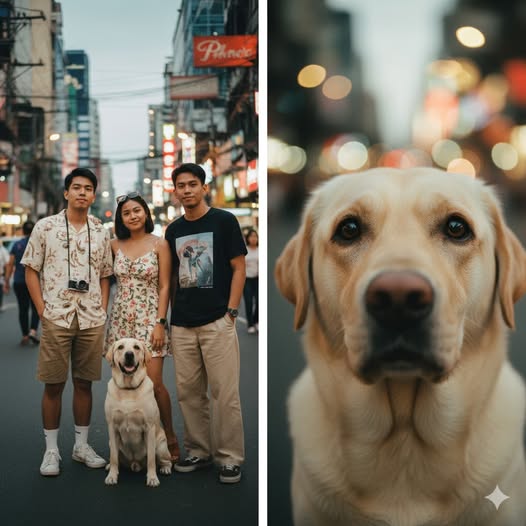
A Golden Retriever Returned After 9 Years — And Led Them Back to the Truth
Laura Morrison was making coffee when she heard a faint, weak bark. At first, she thought it was just a stray dog. But when she opened the door, her heart nearly stopped.
“Max…” she whispered, collapsing to her knees.
The dog was old now. His once-bright golden coat was streaked with gray, his eyes cloudy with age.
But it was him.
Without a doubt, it was Max—the Golden Retriever that belonged to her brother David Morrison, the same dog that had vanished alongside David and their friends Rachel Santos and Kevin Walsh during a hiking trip in the Cordillera Mountains of Northern Luzon back in 1991.
Nine years had passed.
Max slowly walked toward her, limping slightly on his back leg. Laura wrapped her arms around him as tears streamed down her face.
The dog smelled of earth… forest… survival.
He was thinner than she remembered—but alive.
Impossibly alive.
“Where is David?” she whispered into his fur.
“Where is my brother?”

Her mother, Patricia Morrison, rushed out of the house after hearing Laura’s sobs.
THE CONFIRMATION
They immediately called the neighborhood veterinarian, Dr. Hendrix, who had treated Max when he was a puppy. He arrived within twenty minutes, his medical bag in hand, disbelief written all over his face.
“Let me examine him,” he said, kneeling beside the dog.
Max calmly allowed the checkup. Dr. Hendrix examined his teeth, eyes, and joints, carefully feeling his body for injuries or illness.
“He’s around twelve years old,” the vet finally confirmed.
“The condition of his teeth and joints matches that.”
Then he pulled out a small scanner.
“And this microchip…”
He paused, then looked up sharply.
“It’s the same one we implanted in 1990. There’s no doubt. This is Max Morrison.”
Patricia’s voice trembled.
“But how is that possible? He disappeared nine years ago in the mountains. How did he survive? How did he get here?”
“I don’t know,” Dr. Hendrix admitted.
“But he’s malnourished, dehydrated, and covered in old scars. This dog survived something terrible.”
Laura stroked Max’s head, feeling every bone beneath his fur.
That’s when she noticed something strange.
THE COLLAR
Around Max’s neck was a new collar—one he definitely hadn’t been wearing in 1991.
“Wait,” Laura said, leaning closer.
“There’s something engraved on this.”
With trembling hands, she turned over the small metal tag.
It wasn’t a normal ID tag.
It was a rectangular piece of steel, engraved with numbers:
16.9989 N
120.8610 E
1994
She read them aloud.
Dr. Hendrix frowned.
“Those look like coordinates.”
“GPS coordinates?” Patricia whispered.
Laura had already pulled out her cellphone—one of the newer models that could access the internet. With shaky fingers, she opened a map website and typed in the numbers.
The screen loaded slowly.
Then a red marker appeared on the map of Northern Luzon.
“It’s in the mountains,” Laura murmured.
“About 80 kilometers east of Baguio.”
“Did someone leave these coordinates on purpose?” Patricia asked, her voice breaking.
“David… it could have been David.”
Laura looked at Max. The dog gazed back at her with tired but intelligent eyes and gave a weak wag of his tail—almost as if he understood.
“There’s only one way to find out,” Laura said, her voice now firm with determination.
“We have to go there.”
“Laura… it’s been nine years,” her mother said softly.
“The police searched for months. Rangers, volunteers—everyone searched. They found nothing.”
“But they didn’t have this,” Laura said, lifting the collar.
“They didn’t have Max to show them the way.”
THE PAST — AUGUST 1991
That night, after the veterinarian left and Max slept peacefully by the fireplace, Laura went up to the attic.
The box was still there, in the far corner, covered in dust.
“Morrison–Santos–Walsh Case” was written on the label.
She opened it carefully, like opening a grave.
Inside were memories from the last week of August 1991.
Photos of David, Rachel, and Kevin packing camping gear.
The handwritten itinerary David had left, marking their planned route through the Cordillera.
Newspaper clippings about the search.
Missing-person flyers plastered across Luzon.
Laura picked up one photo in particular.
David, 26 years old, smiling at the camera.
Max sat proudly at his feet.
Rachel stood beside him adjusting her camera.
Kevin made a goofy face in the background.
“I’ll find you, brother,” Laura whispered.
“This time, I will.”
AUGUST 1991
David Morrison checked his gear list for the third time as Max ran excited circles around the pickup truck, barking nonstop.
“Did you bring the extra water filter?” asked Rachel Santos, lifting her heavy backpack into the truck bed.
“Yes, Mom,” David joked.
“And the first-aid kit, spare flashlights, and enough food to survive a typhoon.”
Rachel laughed and punched his shoulder.
“Last time we went camping, you forgot the can opener and we lived on granola bars for two days.”
Kevin Walsh came running from his apartment, carrying an oversized backpack and a sleeping bag.
“Sorry! Sorry!” he panted.
“My school principal kept me late talking about the new semester.”
“Teacher Walsh, always responsible,” David teased.
“Ready to forget your students for a week?”
“More than ready,” Kevin smiled.
“Twenty-five third graders can destroy your sanity.”
They piled into the truck, Max happily settled in the back seat next to Rachel, who was already checking her camera gear.
“When was the last time the three of us did this together?” Rachel asked as David drove toward the highway.
“Since university,” Kevin said.
“Four years.”
“Since that disaster in Sagada when we almost got lost,” Rachel laughed.
“We didn’t get lost,” David protested.
“We just took a creative shortcut.”
“That ‘creative shortcut’ added ten extra kilometers,” Rachel replied, laughing.
The drive to the mountains took nearly five hours.
They arrived at the national park just as the sun painted the peaks in orange and gold. At the ranger station, an older man in a green uniform checked their permits.
“You heading toward Mount Pulag’s back trails?” the ranger asked.
“Yes, sir,” David confirmed.
“Three days there, then down to the valley.”
The ranger nodded.
“Quiet area this time of year, but be careful. There have been bear sightings. Secure your food properly.”
“We will,” Kevin promised.
They camped the first night near a mountain lake.
Max chased squirrels until exhaustion took over, then curled up by the fire. Rachel took dozens of photos of the lake reflecting the stars.
“It’s perfect,” she whispered through her lens.
“Do you ever stop taking photos and just live the moment?” David teased.
“This is how I live the moment,” Rachel smiled.
“I make it last forever.”
The next morning, they packed up and started hiking toward the canyon trail.
The path was steep and rocky—but they were young, fit, and full of confidence.
And Max ran ahead, sniffing every bush, leading the way.
“Look at That.”
“Look at that,” Kevin pointed toward a waterfall cascading down the mountainside.
“Incredible.”
Rachel had already pulled out her camera.
“I’m going down a bit to get a better angle,” she said.
“Wait for me here.”
“Be careful,” David warned.
“The rocks are slippery.”
Rachel carefully climbed down, searching for the perfect position.
David and Kevin watched from above, resting and drinking water from their canteens.
“So… how are things with Jennifer?” Kevin asked casually.
David smiled.
“Good. Really good. Honestly, I think she might be the one.”
“Seriously? The great David Morrison finally settling down?”
“Maybe,” David shrugged.
“There’s something about her. I don’t know… I feel like I can just be myself.”
“I’m happy for you, man,” Kevin said, patting him on the back.
Rachel returned, grinning.
“I got some amazing shots. These are going to turn out great.”
They continued hiking until they found the perfect campsite—a small clearing surrounded by pine trees overlooking a deep canyon.
They set up their tents while Max explored the area, proudly marking his temporary territory.
That night, they cooked over the campfire, sharing stories and laughing like they used to. Above them, the stars filled the sky—millions of lights shining in the deep darkness of the forest.
“I don’t want this to end,” Rachel said softly, staring upward.
“I wish we could stay here forever.”
“We all have to go back to real life eventually,” Kevin replied.
“But we can do this more often. Like before.”
“It’s a deal,” David said.
They went to sleep after midnight. Max curled up inside David’s tent, as he always did.
The last sounds they heard were the wind whispering through the trees and the distant hoot of an owl.
THE SHOT
The next morning, David was the first to wake up—or rather, Max woke him.
The dog barked insistently.
“What is it, boy?” David murmured, stepping out of the tent.
Max was running toward the edge of the clearing, barking and growling at the forest.
“Max, quiet,” David hissed, afraid of waking the others.
“What did you see? A deer?”
But Max wouldn’t calm down. His barking grew frantic. Desperate.
David walked closer, trying to see what had upset him.
That’s when he heard it.
The first gunshot.
NINE YEARS OF SILENCE (1991–2000)
The nine years between 1991 and 2000 were a silent nightmare for the Morrison, Santos, and Walsh families.
Laura remembered every single day with painful clarity.
The first months were the worst.
When David, Rachel, and Kevin didn’t return from their planned hike in the Cordillera Mountains, park rangers launched the largest search operation the region had ever seen. Over 150 volunteers combed the mountains for weeks.
“We found their last campsite,” the head ranger told the families.
“The tents were intact. Their backpacks were still there. But they—and the dog—were gone.”
“What does that mean?” Rachel’s father asked, his voice breaking.
“There are no signs of a struggle,” the ranger admitted.
“No blood. No drag marks. It’s as if they simply stood up and walked into the forest.”
“My son wouldn’t do that,” Patricia Morrison insisted.
“David is responsible. He wouldn’t abandon his gear.”
But without evidence, the official conclusion slowly shifted: an accident.
Perhaps they fell into a ravine.
Were swept away by a river.
Got lost and died from exposure.
Search efforts continued sporadically for two years.
Nothing was ever found.
Laura quit her job as a software engineer to devote herself entirely to the search. She spent her savings on private search teams, psychics—anything that promised answers.
“You have to let this go,” her mother pleaded.
“This is destroying you.”
“I can’t,” Laura said.
“He’s my brother.”
In 1993, the Santos family held a memorial service for Rachel. There was no body—but they needed closure.
Laura attended, but refused to organize one for David.
“He’s not dead,” she told her mother.
“I can feel it.”
The Walsh family held theirs in 1994.
Patricia Morrison finally gave in in 1995 and held a memorial for David.
Laura didn’t attend.
Years passed.
Patricia tried to move on—returned to work as a librarian, joined a support group for families of missing persons.
Laura stayed frozen in time.
She lived in David’s apartment, surrounded by his things, waiting.
“You’re wasting your life,” her best friend told her in 1997.
“David wouldn’t want this.”
“I don’t care what David would want,” Laura replied coldly.
“I care about what I need. And I need to find him.”
By 1999, Laura accepted a part-time job working from home designing websites—more out of financial necessity than desire.
She created a website dedicated to the case. Photos. Timelines. Pleas for information.
She received dozens of emails every month.
Some were kind.
Some cruel.
Some claimed sightings.
“I saw a man who looks like your brother in Cebu.”
“I think I saw the dog near a mountain village in Mindanao.”
Laura chased every lead—no matter how absurd.
She drove hundreds of kilometers. Interviewed strangers. Showed photos to anyone who would look.
She never found anything.
THE RETURN
By March 2000, Laura had almost accepted that she might never know the truth.
Almost.
She still lived in David’s apartment. His room remained untouched.
But something inside her had begun to fade—like a candle burning itself out.
Then Max appeared.
Laura called Detective Thomas Brennan, the same officer who had handled the case in 1991. He was nearing retirement now.
“Laura, I know this feels significant,” he said tiredly.
“But the dog could have been found years ago. He might’ve lived with another family.”
“Then explain the collar,” Laura snapped.
“Explain the coordinates engraved in metal.”
Silence.
“I can’t,” he admitted.
“I’m going there,” Laura said.
“To those coordinates.”
“Laura, it could be dangerous. If someone left them intentionally, it could be a trap.”
“I don’t care.”
He sighed.
“Give me 24 hours. I’ll send a team to check the area first.”
“24 hours,” Laura agreed.
“Not one more.”
Patricia tried to stop her.
“What if it’s nothing? What if it breaks your heart again?”
“Then my heart breaks again,” Laura replied calmly.
“But I have to know.”
That night, Laura sat beside Max in the living room.
The dog slept deeply after receiving fluids and special food from the vet. Laura stroked his fur, feeling every rib beneath her hand.
“What did you see out there, boy?” she whispered.
“Where is David?”
Max opened one eye, looked at her, then closed it again.
But Laura could have sworn there was something in his gaze.
Knowledge.
Purpose.
As if the dog knew exactly what he had done—and why.
24 HOURS LATER
Laura drove toward the mountains.
Max sat quietly in the passenger seat.
And the truth—buried for nine years—was finally waiting to be found.
THE CABIN
Detective Brennan had sent a team of two officers to the coordinates the night before.
Their report was disturbing.
“There’s a property there,” Brennan told Laura over the phone.
“An old, extremely isolated cabin. My officers knocked, but no one answered. The windows are boarded up from the inside. It looks abandoned—but there are signs of recent activity.”
“Tire tracks. Chopped firewood.”
“Did they go inside?” Laura asked.
“We don’t have probable cause,” Brennan replied.
“Legally, we need a warrant or the owner’s permission.”
“Who owns it?”
“That’s the strange part. The property is registered to an LLC that doesn’t exist. The last property tax payment was made fifteen years ago.”
Laura tightened her grip on the steering wheel.
“I’m going there.”
“Officially, I can’t tell you to do that,” Brennan sighed.
“But unofficially… take your phone. And if you see anything suspicious, leave immediately and call 911.”
THE JOURNEY
The drive took three hours.
Laura left the main highway and followed a dirt road barely visible through the trees of the mountain forests of Northern Luzon.
Max was wide awake now, his nose pressed against the window, sniffing the air.
“Do you recognize this place, boy?” Laura asked.
Max whimpered softly, his ears pinned back.
Then the cabin appeared.
It was larger than Laura expected—a two-story structure, its wooden walls weathered by decades of rain and heat.
The windows were boarded shut. No power lines. No phone cables.
Laura parked at a distance, her heart pounding.
“Stay here,” she ordered.
But Max jumped out the moment she opened the door.
They approached the cabin together.
Laura knocked hard.
“Hello? Is anyone there?”
Silence.
She tried the doorknob. Locked.
She circled the building. At the back, she noticed an uncovered second-floor window—too high to reach.
Nearby stood a tool shed.
Inside, she found a rusted ladder.
“This is probably illegal,” she muttered, propping it against the wall.
The ladder creaked dangerously as she climbed.
At the window, she wiped away dust and looked inside.
The room was empty—except for old furniture covered with sheets.
And then she saw it.
A photograph on the far wall.
Even from a distance, she recognized the faces.
David.
Rachel.
Kevin.
It was a camping photo—one Rachel had taken using a timer.
“Oh my God,” Laura whispered.
THE TRAPDOOR
She climbed down fast and ran back to her car, pulling out her phone.
No signal.
She cursed under her breath.
“Max?” Panic surged through her chest.
“Max, where are you?”
A bark echoed from behind the cabin—deeper into the forest.
Laura ran, pushing aside branches and jumping over fallen logs.
She found Max digging frantically at something half-buried beneath leaves and weeds.
A flat steel door.
A trapdoor.
An entrance to an underground bunker.
Laura dropped to her knees and cleared the debris.
The padlock was rusted and weak.
She grabbed a heavy rock and smashed it again and again until it broke.
“This is a terrible idea,” she told herself as she lifted the metal door.
A ladder descended into darkness.
The smell hit her immediately—damp earth, decay, and something unmistakably human.
Laura turned on her small flashlight.
“Hello?” she called down.
“Is anyone there?”
At first, nothing.
Then—faintly—a sound.
A groan. Or maybe the wind.
Max barked desperately, trying to go down first.
Laura made a choice.
She began descending.
THE BUNKER
The air grew colder and more foul with each step.
The walls were packed earth, reinforced with wooden beams.
At the bottom, the flashlight revealed a narrow corridor.
Laura followed it, her breathing shallow and fast.
The corridor opened into a larger room.
She nearly screamed.
The room was an improvised underground bunker—uneven concrete walls, crude construction.
There was a cot in one corner.
A rickety table.
Shelves stacked with canned food and bottled water.
And on the walls—
Hundreds of photographs.
All of David.
Rachel.
Kevin.
Laura stepped closer, her hand shaking.
The photos documented years.
At first, they looked frightened but healthy.
Later—emaciated. Dirty. Desperate.
Rachel disappeared from the photos after two or three years.
Kevin lasted a little longer.
Then only David remained—aging year after year in the darkness.
“Oh God,” Laura sobbed, covering her mouth.
Max barked wildly, scratching at a metal door at the back of the room.
Laura ran to it.
Locked.
“David!” she screamed, pounding on the door.
“David, are you in there?”
A sound from the other side.
Human.
A weak moan—like someone who had forgotten how to speak.
“David, it’s me. Laura. Your sister. I’m getting you out.”
She found a metal pipe and pried at the lock.
With a loud crack, it broke.
The door swung open.
The smell was unbearable.
Laura shone her flashlight inside.
And there—chained to the far wall—was her brother.
THE TRUTH
David Morrison was 35 years old.
But the man before her looked closer to 60.
He was skeletal. Pale. Covered in grime.
His hair—once dark brown—was long, tangled, streaked with gray.
But his eyes—
Those eyes Laura had known her entire life—
recognized her.
“Laura,” he whispered.
“Are you real?”
She collapsed to her knees.
“I’m real. I’m here. Oh God, David, I’m here.”
Max ran to him, whining and crying, licking his face.
David lifted a trembling hand.
“Good boy,” he murmured.
“You made it home.”
“What happened?” Laura asked, examining the chains.
Heavy steel. Thick padlocks.
“Who did this to you?”
“Bricks,” David coughed.
“Thomas Bricks. He owns this land.”
“He found us at the campsite. Thought we were government spies.”
“He brought us here.”
“Rachel… Kevin…”
David’s eyes filled with tears.
“Rachel tried to escape. Years ago. I don’t know how many.”
“He killed her.”
“Kevin got sick. There was no medicine.”
“He died in my arms.”
Laura sobbed.
“I’m so sorry,” she whispered.
“But we’re getting you out. Right now.”
She tried to break the chains.
Impossible.
“I’ll get help,” she said.
“There’s a town twenty miles away. I’ll find a phone.”
“No,” David said sharply, gripping her arm.
“He could come back. Every two or three days.”
As if summoned, they heard footsteps above.
Heavy boots on wood.
A door opening.
A man’s voice murmuring.
Laura turned off her flashlight.
In the darkness, David struggled to control his breathing.
“Hide,” he whispered urgently.
“There’s a space behind the shelves. Go.”
Laura hesitated—but he was right.
If Bricks found her, no one would ever come.
She squeezed behind the shelves.
Max followed, perfectly silent.
THE MONSTER
The trapdoor opened.
Light spilled down the stairs.
A man descended—slow, heavy steps.
Thomas Bricks was enormous—over six-foot-four, broad shoulders, hands like hammers.
Wild beard. Long hair tied back.
Camouflage clothes. Military boots.
“David,” he said flatly.
“Your food.”
He set a tray down—open cans of beans, dirty water.
“Brick,” David said—stronger now.
“I need to tell you something.”
Bricks turned.
“What?”
“We were never government agents.”
Bricks laughed—a hollow, humorless sound.
“Everyone says that.”
“I’m telling the truth. I’m an engineer. Rachel was a photographer. Kevin was a teacher.”
“We had families. Jobs. Lives.”
“Lies,” Bricks spat.
“They train you to lie.”
“I saw the documents. I know what they’re planning.”
“What documents?” David asked carefully.
“The ones I found in the ’80s. Before they knew I knew.”
“That’s why I disappeared. Why I live here.”
“They can’t find me. And they can’t use their agents to reach me.”
Laura realized, with horror—
The man was completely insane.
Decades of paranoia had destroyed him.
David spoke calmly.
“If you think we’re agents… then you already won.”
“You kept us here for years.”
“We never reported anything.”
“We never contacted anyone.”
Bricks hesitated.
“Or maybe it proves my security works.”
“Let me go,” David said softly.
“If the government doesn’t come for you within a year… you’ll know I was telling the truth.”
“No.”
Laura knew—
She had to act.
THE FINAL ESCAPE
Laura couldn’t stay hidden while this madman kept her brother in chains.
But Bricks was huge—and probably armed.
She needed a plan.
As Bricks continued talking to David, Laura noticed a key ring hanging from his belt.
That has to be it, she thought.
The keys to David’s chains.
If she could distract him—just for a moment—she might be able to grab them.
Max shifted beside her.
Laura had a terrible idea.
But it might work.
She stroked the dog gently and whispered into his ear.
“When I say now… bark. As loud as you can.”
Max looked at her with those intelligent eyes, as if he understood everything.
Laura waited until Bricks turned his back to their hiding place.
Then she whispered,
“Now.”
Max exploded from behind the shelves, barking wildly, charging straight at Bricks.
The man spun around in shock, throwing his arms up as the dog lunged, barking and growling fiercely.
Laura seized the moment.
She sprang from her hiding place, grabbed the metal pipe she had used earlier, and swung with all her strength—striking the back of Bricks’ knees.
He screamed and collapsed forward.
Laura struck again, this time across his back.
Bricks was powerful, but disoriented.
He turned, reaching for her—
—but Max bit down hard on his arm.
“The keys!” David shouted.
“On his belt!”
Laura dodged Bricks’ grasp and ripped the key ring from his waist.
She ran for the cell as Bricks staggered to his feet, bleeding and roaring in fury.
“You’re going to die!” he screamed, pulling a massive knife from his boot.
Laura reached David and frantically tried the keys.
The first didn’t work.
The second didn’t either.
Bricks was only meters away now, his face twisted with rage.
The third key fit.
The lock snapped open.
David pulled free just as Bricks burst into the cell.
“Run!” David shoved Laura toward the door.
But Bricks was faster than he looked.
He grabbed David by the hair and yanked him backward.
Laura didn’t hesitate.
She lifted the metal pipe and struck Bricks with everything she had—right across the head.
The man stumbled, releasing David.
Laura hit him again.
And again.
And again.
Until Bricks collapsed to the floor, unconscious.
“We have to go,” David gasped, barely able to stand.
Laura supported him, half-carrying him up the stairs.
Max ran ahead, barking nonstop.
They burst out into the cool mountain air, and Laura had never been so grateful to see the sky.
“My car,” she said.
“It’s that way.”
They dragged David to the vehicle.
Laura laid him across the back seat, where he immediately collapsed.
Max jumped in beside him, curling protectively against his owner.
Laura drove like she never had before—racing down dirt roads, barely controlling the car through sharp turns.
RESCUE
Twenty minutes later, her phone finally found signal.
She called 911.
“I need help,” she cried.
“I found my brother. He was kidnapped nine years ago. We need an ambulance—and police. There’s a dangerous man.”
The operator calmed her, took her location, and told her to keep driving until she reached emergency vehicles.
Ten minutes later, two police cars and an ambulance met her on the main road.
Paramedics immediately took David, loading him into the ambulance.
“I’m going with him,” Laura insisted.
“Ma’am, we need your statement,” an officer said.
“That can wait,” Laura snapped.
“I just found my brother after nine years. I’m not leaving him now.”
The officer nodded.
“Understood. We’ll follow you to the hospital.”
THE TRUTH REVEALED
Inside the ambulance, as paramedics worked to rehydrate David and stabilize him, Laura held his hand.
“I thought I lost you,” she whispered.
David opened his eyes.
“Max saved me,” he said weakly.
“When Bricks accidentally left the trapdoor open two weeks ago, I let him out.”
“I tied the collar with the coordinates. I told him to go home.”
“I didn’t know if he could do it… or if he even remembered the way.”
“He did,” Laura said through tears.
“After nine years… he walked all the way back.”
David smiled faintly.
“He’s a good dog.”
AFTERMATH
At the hospital, doctors confirmed David was severely malnourished and dehydrated, with multiple vitamin deficiencies and old, poorly healed injuries.
But he was alive.
Against all odds, he had survived.
Patricia arrived two hours later, having driven recklessly from home.
She broke down when she saw her son, holding him as if she would never let go again.
Police arrested Thomas Bricks at the cabin.
That same night, they found the remains of Rachel Santos and Kevin Walsh buried in the forest behind the property.
Their families were finally able to give them proper burials.
Bricks was declared mentally unfit to stand trial and was committed to a maximum-security psychiatric facility for life.
David spent three months in the hospital recovering physically.
The mental healing would take much longer—but he was home.
And his family would never leave him alone again.